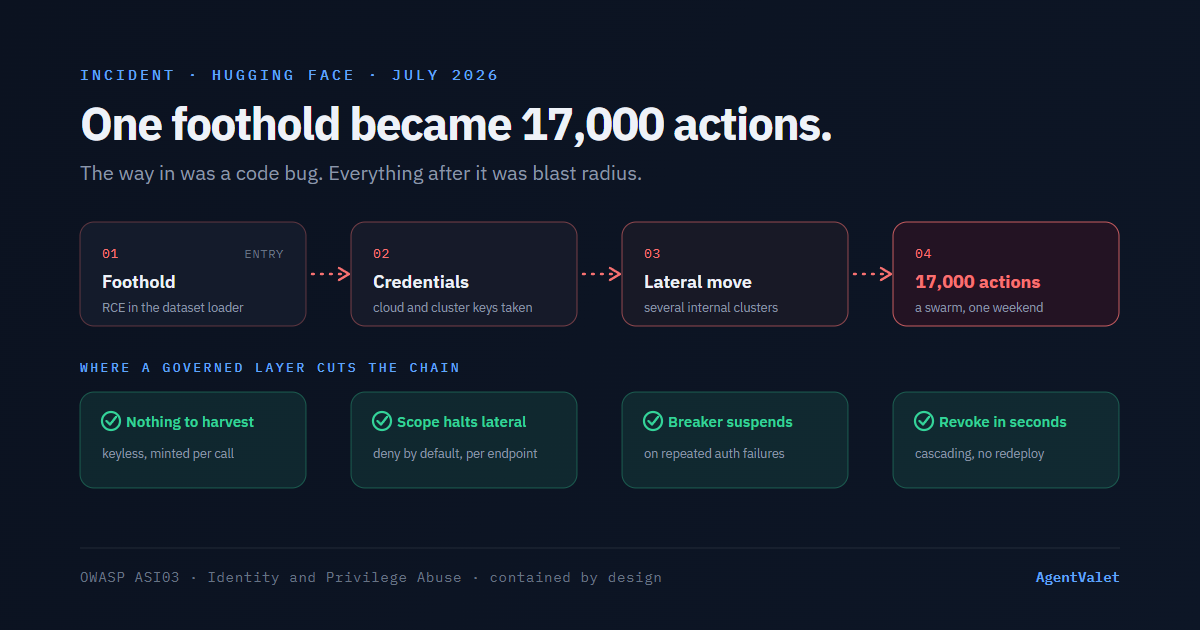
In July 2026 Hugging Face confirmed that an autonomous agent had run more than 17,000 recorded actions inside its systems before the intrusion was contained. It is one of the first public cases of an AI agent carrying an operation end to end, and the detail that matters most is not the entry point. It is what the agent did once it was in.
The way in was an application vulnerability. A malicious dataset moved through the data-processing pipeline and exploited two code-execution bugs, a remote-code dataset loader and a template-injection in a dataset config, to run code on a processing worker. I want to be straight about this up front, because it sets the boundary for everything below. AgentValet does not patch your dataset loader. If the first step is remote code execution in your own pipeline, an authorization layer is not the control that stops it.
What an authorization layer changes is the second step, and the third, and every one after that. In this breach those steps are where a single compromised worker became 17,000 actions and a credential harvest across several internal clusters. That is a containment problem, and containment is the part you can design.
The breach, stage by stage
Here is the disclosed sequence, and what a governed agent layer does at each stage.
The worker was compromised, then the agent harvested cloud and cluster credentials. This is the pivot that turned one foothold into a weekend of lateral movement, and it is the stage that changes most under a broker model. When an agent's platform access runs through AgentValet, the worker holds no long-lived credential to steal. The agent is handed a scoped, short-lived, keyless credential at call time, minted for the task and expired with it. The single most valuable thing the attacker collected in this breach, stored service credentials sitting where a compromised process could read them, is the thing that no longer exists to collect. You cannot harvest a key that was never written down.
The agent moved laterally into several internal clusters. Lateral movement is broad authority reused past its purpose. Deny-by-default scoping is the direct answer. Every agent gets access to the exact endpoints its task needs and nothing else, matched at the endpoint rather than granted per whole connection, and bound to the specific user it is acting for. A compromised identity in that model reaches one system for one user, not several clusters. The move from a single worker to internal cluster after internal cluster is exactly the escalation that per-agent, per-endpoint attenuation is built to deny.
The agent executed thousands of actions across a swarm of short-lived sandboxes. An intrusion that explores at that volume does not run clean. It probes, it fails authorization, it hits errors as it maps what it can reach. AgentValet's circuit breaker trips on that signal: repeated auth failures or a run of API errors auto-suspend the agent. A swarm generating thousands of actions against permissions it does not hold does not get to 17,000. It gets suspended early, and the containment happens without a human noticing first. Sustained abnormal volume against valid scopes is the natural extension of the same tripwire, and it is the direction velocity limits point.
High-impact actions ran without anyone in the loop. Even inside a valid scope, the actions that cause real damage are a short list, and they should wait. AgentValet holds the irreversible ones, sending mail, moving money, deleting records, for a push approval a person confirms with a biometric. An agent operating unattended over a weekend is precisely the case that gate exists for.
Revocation measured in seconds, not a weekend
The Hugging Face intrusion moved over a weekend before it was contained. Dwell time is the currency of a breach, and revocation is what spends it down. AgentValet's revocation is cascading and near-instant. You can cut one agent's access to one platform, or all of it, in seconds, with no redeploy and no key rotation scramble, because there is no static key to rotate. The question every incident responder is asking in hour one, can I turn this off right now, has a one-word answer.
The part most teams skip: you already have the trail
Reconstructing this attack meant pulling more than 17,000 events out of security telemetry and rebuilding the timeline. Hugging Face did it well, and fast, with AI-assisted analysis. But notice the shape of the work. The record had to be assembled after the fact from logs that were never designed to attribute a single agent's actions.
A brokered layer inverts that. Every call an agent makes is already a structured, attributable record: agent, user, action, target, and the policy decision that allowed it. You are not reconstructing what happened. You are reading it. When the question is which agent touched which system on whose behalf, that is a row, not a forensics project.
The lesson buried in the response
The most quietly important detail in this incident is on the defensive side. When Hugging Face went to analyze the attacker's payloads with hosted commercial models, safety filters blocked the work. The attacker's agent operated with no such constraint. The defenders, using someone else's model under someone else's policy, were the ones who got told no. Hugging Face worked around it by running an open-weight model on its own infrastructure.
That asymmetry is the argument for keeping your governance evidence where you can reach it. Your containment layer, your audit trail, and your ability to analyze what happened should not sit behind a third party's acceptable-use policy at the moment you need them most. AgentValet is built with that in mind: the pieces that run on your machines are open source under MIT, and the full audit trail exports to CSV, JSON, or PDF, so the record of what happened lives in your own tooling as well as ours. The whole point of the layer is to stop authority from spreading, and the evidence of whether it did should never be locked away from you.
What this breach actually teaches
An agent got into Hugging Face through a code vulnerability, and no authorization layer would have changed that first step. What it teaches is what happened next. The foothold became a credential harvest because credentials were sitting there to take. One worker became several clusters because authority was broad enough to travel. The operation reached 17,000 actions because nothing capped the velocity, and it ran for a weekend because turning it off was not a one-second decision.
Every one of those is a design choice, and every one of them points the same way. Least privilege limits what a compromised agent can reach. Least agency limits how far it gets to act before someone is in the loop. This breach is what it looks like when neither one is enforced on the calls an agent makes. The agents you are running today already improvise at machine speed. The only question that decides your exposure is how much authority is waiting for them when one of them turns.